.jpg)

Shoulder pain is one of the most common injuries among fitness athletes.
Whether you do CrossFit, Olympic weightlifting, F45, Orange Theory, or train in your garage, around 25% of us will experience shoulder pain at some point in our training career.
If you're dealing with shoulder pain in Rocky Hill, CT or the surrounding area, you're not alone—and you don't have to figure it out by yourself.
In this guide, we're going to cover:
- Basic shoulder anatomy (and why it matters)
- Why the shoulder is particularly vulnerable to injury
- How we categorize different shoulder injury types
- What you need to know about rehabbing shoulder pain
Let's dive in.
Shoulder Anatomy Basics: The Most Mobile (and Vulnerable) Joint
The shoulder is a pretty remarkable joint.
It has the largest freedom of movement of any joint in our body and is designed to allow us to reach in all directions in order to interact with our environment—think reaching for fruit on high tree branches as our ancestors were evolving, along with activities like throwing, carrying, lifting overhead.
The Shoulder Girdle: Three Bones Working Together
The shoulder girdle is composed of three main bones:
- Humerus (upper arm bone)
- Scapula (shoulder blade)
- Clavicle (collar bone)
These three pieces of the system all need to move in a coordinated way in order to achieve full range of motion in all directions.
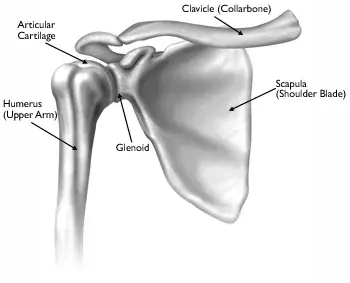
Fig. 1 Bones of the Shoulder Girdle
The "Golf Ball on a Golf Tee"
The glenohumeral joint is commonly thought of as a "ball and socket" joint. But really, the bony anatomy is more similar to a golf ball on a golf tee.
There isn't a lot of bone that holds it in place.
Instead, the joint relies on:
- The labrum
- Ligaments
- Joint capsule
- Rotator cuff muscles
...to keep the shoulder joint centrated and in an ideal position.
If these tissues get stretched or stiffen up, that can cause issues for the positioning of the shoulder joint and lead to pain or dysfunction.
The Rotator Cuff: Your Shoulder's Stabilization System
The rotator cuff is a group of 4 muscles that primarily help stabilize and centrate the shoulder joint.
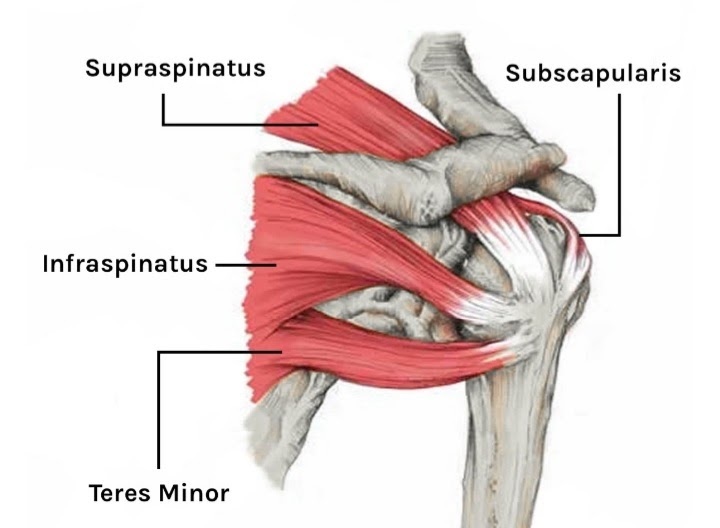
Fig. 2 Rotator Cuff Muscles
Functionally, these muscles work as a group to keep the golf ball on the golf tee while your shoulder moves in all different directions.
If one muscle is weak, irritated, or lacks efficiency, this is a common cause of joint dysfunction.
These four muscles are playing a very coordinated game of "tug of war" with your joint, with each pulling differently based on the orientation of your shoulder and the demands of your activity.
When one can't pull its weight, that can cause issues.
This is why generic shoulder exercises you find online often don't work—they're not addressing YOUR specific weakness or imbalance.
The 3 Types of Shoulder Pain Presentations
At Pack Performance PT in Rocky Hill, we categorize shoulder pain into three main buckets:
- Weak Shoulder
- Stiff Shoulder
- Mobile Shoulder
Understanding which type you have is critical—because each requires a completely different treatment approach.
Type 1: The Weak Shoulder
In the weak shoulder presentation, we find significant weakness in one or more of the muscles or movement patterns around the shoulder and high levels of irritability in multiple directions.
Common signs:
- Pinching pain as you raise your arm overhead (impingement syndrome)
- Pain at the start of a session that gets better once you warm up
- Visible size differences in muscles (deltoid, lats, rhomboids)
- Irritable/painful shoulder motion in multiple directions
What's happening: Weakness or inefficiency of your rotator cuff muscles can cause the golf ball to shift out of ideal position on the tee while it's moving, leading to pinching, irritation, and pain. We may also see weakness in the intrascapular muscles = (rhomboids, traps, etc) and posterior shoulder leading to abnormal loading around the shoulder and other muscles working harder to pick up the slack.
How we treat it:
- Strength training for weak muscles and movement patterns
- Hypertrophy work to build size
- Rotator cuff efficiency training
- Progressive loading protocols
Type 2: The Stiff Shoulder
In the stiff shoulder presentation, one or more components of the shoulder girdle is stiff, leading to limited range of motion.
Common signs:
- Can't reach or lift overhead without arching your back
- Limited ability to reach behind your back
- Tightness in lats, pecs, anterior shoulder or thoracic spine
- Restricted movement in multiple directions
What's happening: Commonly, the lats are stiff (preventing overhead motion), or the pecs and anterior deltoid are tight (restricting shoulder extension/reaching behind the back). We can also see stiffness in the joint capsule itself, which will restrict range of motion depending on which portion has tightened up. Limited thoracic spine motion is also common in these patients, further restricting motion at the shoulder.
How we treat it:
- Mobility work to restore range of motion
- Progressive strengthening in new ranges
- Focus on eccentric (lengthening) exercises
- Gradual tissue adaptation protocols
Type 3: The Mobile Shoulder (The Tricky One)
This is the most challenging shoulder pain presentation to treat because these patients have plenty of range of motion already—oftentimes too much!
Common signs:
- You're very flexible but still have shoulder pain
- History of shoulder subluxation (partial dislocation)
- You're hypermobile at most joints in your body
- You feel "tight" but stretching doesn't help
- Pain at end ranges of motion
What's happening: These patients require stability and strength at end range. The "tightness" they feel is actually a protective sensation designed to keep their body out of extreme ranges they can't control. Their muscles don’t have the requisite strength and motor control and the joint structures and passive tissues become irritated as they take the brunt of the loading.
People with hypermobility disorders like Ehlers-Danlos Syndrome often present with this type of shoulder pain.
How we treat it:
- Tempo-focused strength training
- Isometric holds at end range to build control
- Stability-based strength taining (like bamboo bar presses)
- NOT stretching (this often makes it worse!)
Why Getting the Type Wrong Makes Things Worse
Here's the problem with Dr. Google and ChatGPT for shoulder pain:
If you have a hypermobile shoulder and you keep stretching it because that's what you found online, you're likely not going to see the improvement you're hoping for—and you may make it worse.
Likewise, if you have a stiff shoulder and you only do strength work without addressing mobility, you'll stay stuck.
This is why assessment matters more than guessing.
At Pack Performance PT in Rocky Hill, we don't guess. We assess.
What a Shoulder Evaluation Looks Like at Pack PT
In order to treat your shoulder pain, it's important to fully understand what's driving your pain experience.
Here's what you can expect during your 60-minute initial evaluation for shoulder pain at our Rocky Hill clinic:
- Thorough history of symptoms including what movements, activities, positions, and situations aggravate and alleviate your pain
- Goals setting discussion
- Determine symptom irritability to get a baseline of your current tissue capacity
- Thorough range of motion assessment based on the demands of your activities
- Strength testing to determine what’s weak and not pulling its weight
- Trial treatment and initial exercise program to address symptoms day 1
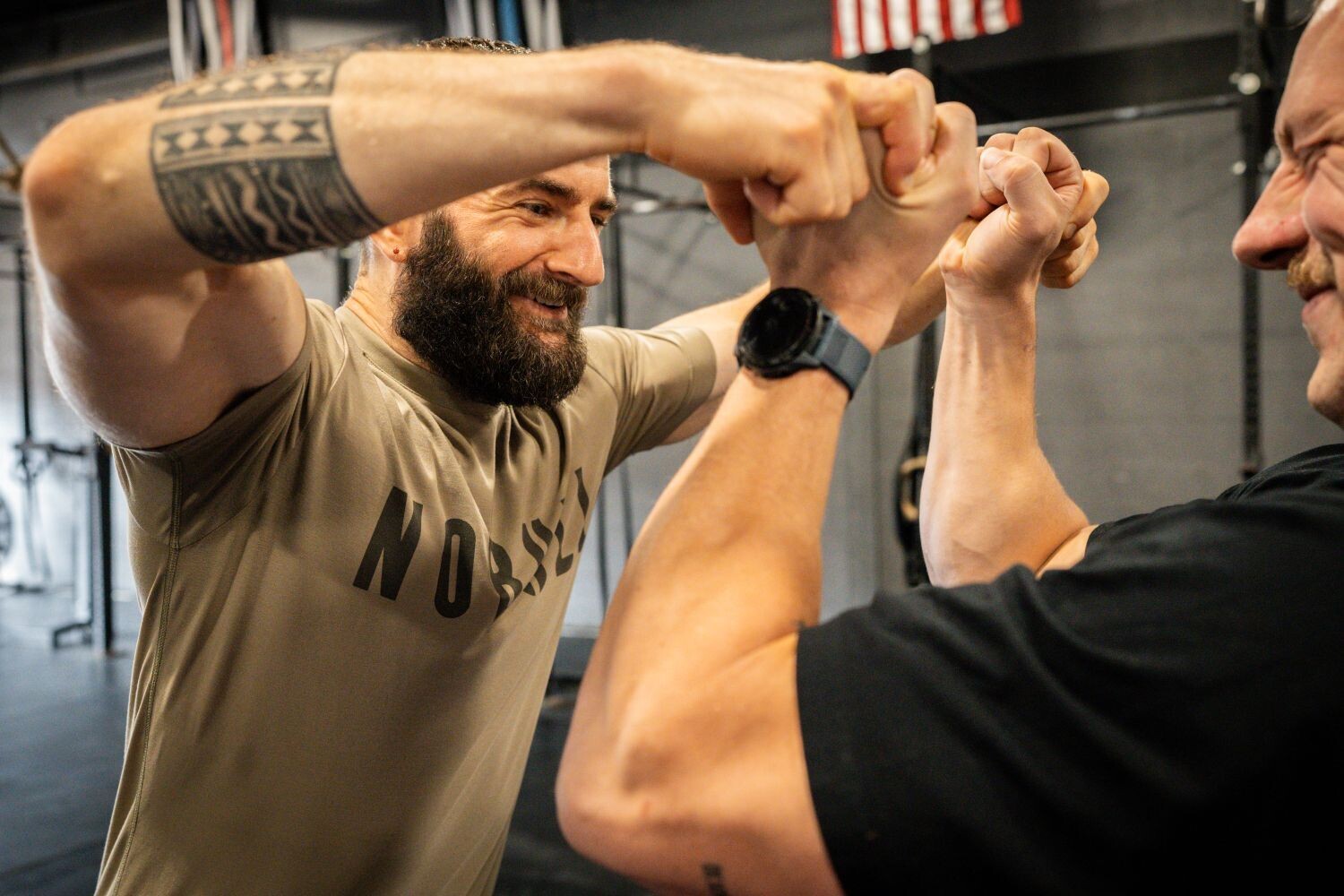
Treatment Plan Development
Once we have a thorough understanding of your pain, we'll build out your initial treatment plan to:
- Improve YOUR weakness, stiffness, or instability
- Provide ongoing support to keep you training while you recover
- Give you a clear path back to doing the activities you love
Common Shoulder Injuries We Treat in Rocky Hill
At Pack Performance PT, we specialize in treating shoulder pain in active adults and athletes throughout Rocky Hill and Central Connecticut.
Common conditions we see:
- Rotator cuff tendinopathy
- Shoulder impingement syndrome
- Labral tears
- AC joint injuries
- Biceps tendinopathy
- Post-surgical shoulder rehab
- Chronic shoulder instability
- CrossFit and weightlifting-related shoulder pain
Why Shoulder Pain Needs More Than Generic Exercises
Remember the I3 Model of Pain?
Your shoulder pain didn't happen overnight. It's the result of:
- Incomplete mechanics (weakness, stiffness, poor movement patterns)
- Accumulated insults (training volume, poor technique, lack of recovery)
- Injury (the point where your shoulder finally says "enough")
This is why it's never one thing. Your shoulder pain has multiple contributing factors, and your treatment needs to address all of them—not just give you a few stretches.
When to Seek Professional Help for Shoulder Pain
You should schedule an evaluation if:
- Your shoulder pain has lasted more than a month and isn’t improving
- Pain is limiting your training or daily activities
- You've tried rest and it keeps coming back
- You're continually modifying workouts to avoid shoulder pain
- You want to prevent a minor issue from becoming chronic
Don't wait until it's severe. Early intervention leads to faster recovery and better outcomes.
What Makes Pack Performance PT Different for Shoulder Pain
At Pack Performance PT in Rocky Hill, Connecticut, we take a Performance Physical Therapy approach to shoulder pain:
- 60-minute one-on-one evaluations - Not 15-minute appointments
- Individualized treatment - Based on YOUR shoulder type, not generic protocols
- Athlete-focused - We understand CrossFit, Olympic lifting, and strength training demands because are athletes ourselves
- Whole human approach - We help you optimize lifestyle factors to improve fitness and wellness
- Return to performance - Not just pain-free, but stronger than before
We serve active adults and athletes throughout Rocky Hill, Newington, Wethersfield, Cromwell, and Central Connecticut who are tired of generic exercises that don't work.
Ready to Fix Your Shoulder Pain?
Stop guessing about what's wrong with your shoulder. Start with Pack PT's at home shoulder mobility assessment and start improving your shoulder range of motion today!
If you're looking for a comprehensive solution, Schedule Your FREE 15 Minute Phone Consultation and we'll answer any questions you have to see if we’re the right fit to help you with your shoulder pain.
Questions? Text us at 860-266-6287 or email dr.matt@packperformancept.com.
Located in Rocky Hill, CT - Serving athletes and active adults throughout Central Connecticut.
Sources
Weisenthal, B. M., Beck, C. A., Maloney, M. D., DeHaven, K. E., & Giordano, B. D. (2014). Injury Rate and Patterns Among CrossFit Athletes. Orthopaedic journal of sports medicine, 2(4), 2325967114531177. https://doi.org/10.1177/2325967114531177
.jpg)
Matthew Szymanski
Contact Me